The Retailers Powering BevAlc Purchasing are Being Overlooked
The engine of the BevAlc industry isn’t found in big-box chains or delivery platforms. It’s local. On the corner, in neighborhood grocery, and at independent liquor stores.
Yet despite driving the majority of transactions, this segment receives a disproportionate share of media investment, a disconnect that’s becoming harder for the industry to ignore.
This collective is the Retail Majority: the independent, regional, and specialty retailers that power BevAlc purchasing.
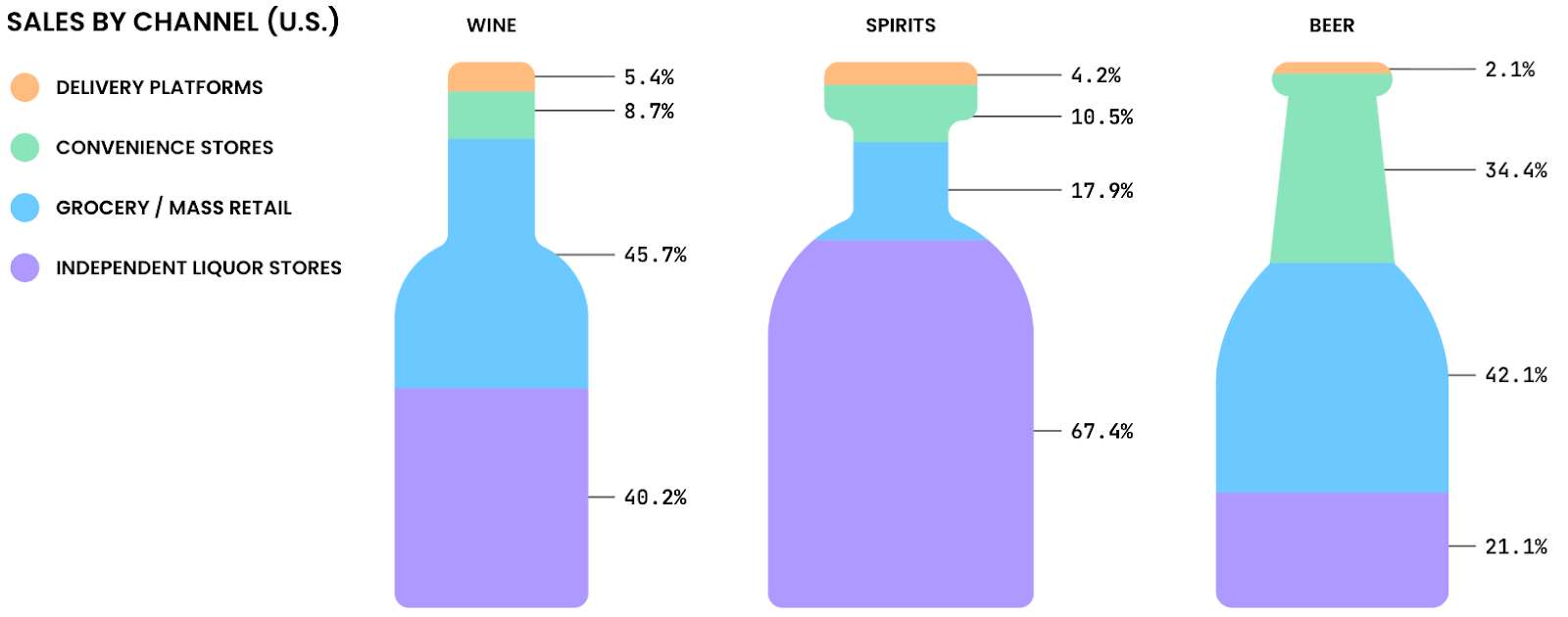
The landscape is highly fragmented. The long tail of BevAlc retailers spans more than 200,000 locations, compared to fewer than 8,000 large national and big-box stores. Large retailers generate higher volume per location, but the long tail drives cumulative scale.
In aggregate, independent, regional, and specialty retailers represent the majority of BevAlc purchase opportunities.
This isn’t a niche. It’s the majority of the market.
The Epicenter of Influence, Proximity, and Habit
Local retail doesn't just capture demand. It shapes it.
The Retail Majority owns the most influential moments of the consumer journey:
- Discovery (Independent Liquor Stores) The frontline for trial. Staff recommendations and curated assortments directly influence purchase decisions and introduce new brands.
- Routine (Regional Grocery) The weekly stock-up. This is where repeat purchasing behavior and brand preference are established over time.
- Immediate Need (Convenience) The moment of proximity. Quick trips, impulse purchases, and replenishment behavior are driven by location and accessibility.
Winning these environments isn’t about one-off conversions. It’s about embedding into consumer habit.
“When economic conditions tighten or confidence softens, shoppers don’t stop buying — they prioritize convenience and familiarity. This shift favors proximity."
- Michael Blanche, Surfside Co-Founder and Co-CEO, in Total Retail
Nearly half of BevAlc shopping journeys begin with digital intent, but most purchases happen at nearby physical retailers (Source: IWSR). These proximity-driven environments shape routine behavior and repeat purchasing.
Brands that win in these moments don’t just gain distribution. They gain repeat purchase, share of wallet, and long-term loyalty.
The Long Tail Is Becoming Addressable
For decades, the Retail Majority has been fragmented and difficult to access at scale. Independent retailers operated in isolation, with limited shared infrastructure for targeting, activation, and measurement.
That’s beginning to change.
New retail media infrastructure is emerging to aggregate independent and regional retailers into unified networks. As ecommerce, loyalty programs, POS integrations, and in-store media become more connected, the long tail is no longer opaque.
For the first time, the Retail Majority is:
- Addressable
- Measurable
- Actionable at scale
This shift closes the gap between media and real-world sales, allowing brands to influence demand where purchase decisions actually happen, not just where impressions are served.
What was once fragmented is becoming a connected, data-driven growth channel.
A Structural Shift in the Market
The Retail Majority isn’t new. It has always been there. What’s changed is the ability to reach it, measure it, and scale it.
As this gap between where transactions happen and where media dollars are spent becomes harder to ignore, brands that move early will be the ones that win the neighborhood, the routine, and ultimately, the category.
We’ll break it down in our next piece.

Advertising and retail media in one place.
Spend smarter, and get more from your stores.